What caught my attention in both videos was how they exposed the invisible labor behind food service work. The breakfast-rush video showed cooks constantly multitasking under pressure while trying to keep up with the pace and customers’ expectations during busy hours. It made me realize that restaurants depend heavily on workers’ ability to handle stress, physical exhaustion, and nonstop movement to maintain fast service. As discussed in class, “If you don’t cook what you eat, someone else does.” This reveals that even when consumers do not prepare their own meals, the food still relies on someone else’s labor behind the scenes, often unnoticed.
The second TikTok revealed another side of food service labor by showing workers rushing to eat, struggling to take breaks, and dealing with exhaustion during long shifts. Together, the videos made me think about how food service jobs normalize overworking and exhaustion as part of the industry. This reflects our class discussion of invisible labor, as the focus is usually on efficiency and customer satisfaction, while the physical and emotional pressure experienced by workers is often ignored and undervalued.
Question:
I wonder why essential food workers are often overlooked despite how important their work is to everyday life?
To what extent are food service workers expected to work through long shifts without proper breaks?
Meal prep videos like this one often show people buying groceries and preparing food on their day off to make busy workweeks easier. At first, these videos may look aesthetic or motivating, but they also reveal the labor behind cooking. Meal prepping involves grocery shopping, cooking, cleaning, organizing, and planning meals ahead of time, which are all forms of unpaid domestic labor. This connects to our discussion of cooking and food work because meal prep is not just a “self-care” routine, but labor that helps people continue working, especially those with long or irregular schedules.
The discussion on food sovereignty and domestic labor also made me realize that cooking at home is not equally accessible to everyone. Meal prep culture often assumes people have enough time, money, energy, and stable schedules to maintain these routines consistently. However, many working-class families may struggle to sustain this lifestyle because of financial stress, caregiving responsibilities, exhaustion, or limited resources. Online meal prep culture can make cooking seem like a personal lifestyle choice, even though class, gender, income, and work conditions strongly shape who is actually able to maintain these routines.
Question:
Does the way meal‑prep culture appears on social media reflect a realistic option for most working people and families, or does it hide how unequal and exhausting domestic food labor can be?
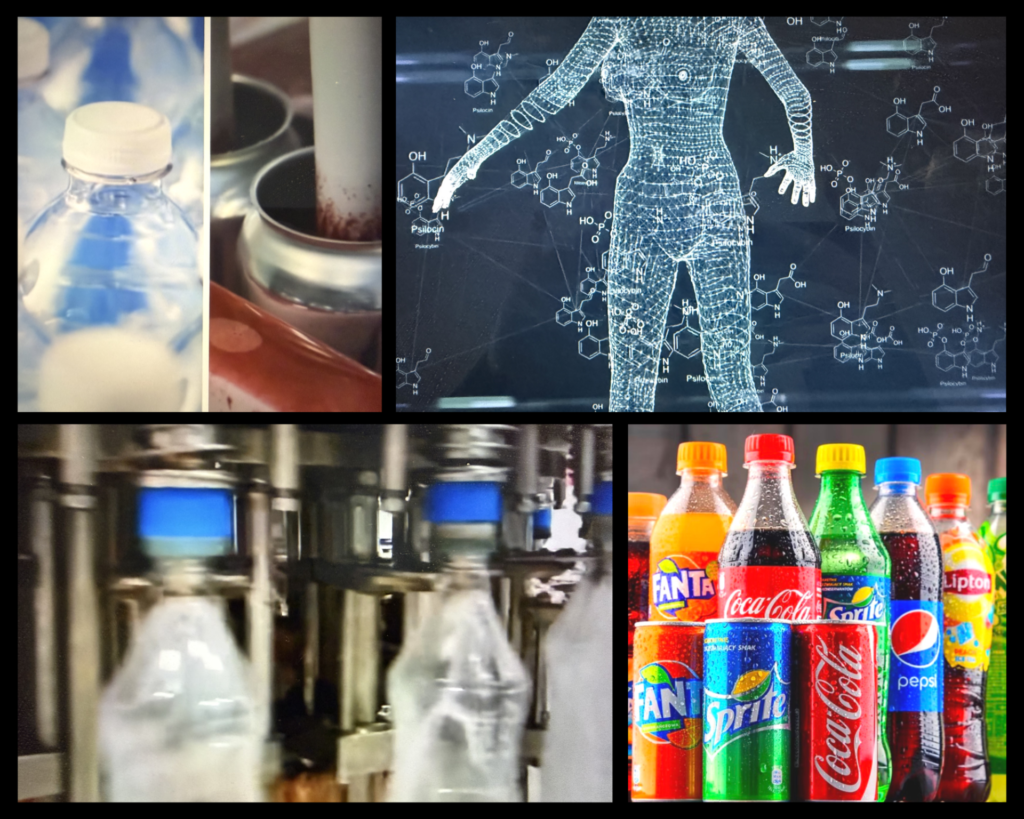
Soda is part of many people’s daily consumption without realizing how unhealthy it can be. It is one of the most commonly produced drinks, and the way it is made raises many concerns. It is usually made from carbonated water and high fructose corn syrup, along with artificial flavors, preservatives, and coloring. Due to this, soda has been linked to health issues like obesity, type 2 diabetes, tooth decay, and heart disease. What stood out to me from the video is how high sugar content is a key part of manufacturing. Many of these drinks contain large amounts of added sugar in just one serving, making them more appealing but also increasing health risks over time. This shows how companies design products to taste good and encourage repeated consumption. To add on, there are also environmental impacts. The production of high-fructose corn syrup requires extensive corn farming, which contributes to pesticide use and environmental damage. In addition, soda packaging, such as plastic bottles and aluminum cans, contributes to pollution, and significant amounts of water are used in production. It can take about 2–4 liters of water to produce just 1 liter of soda, which is especially concerning in areas facing water shortages.
Question: Since sugar content is already listed on labels, if companies were also required to clearly show the environmental impacts and worker conditions behind soda production, do you think that extra information would actually change what people buy, or would most consumers keep choosing soda anyway?
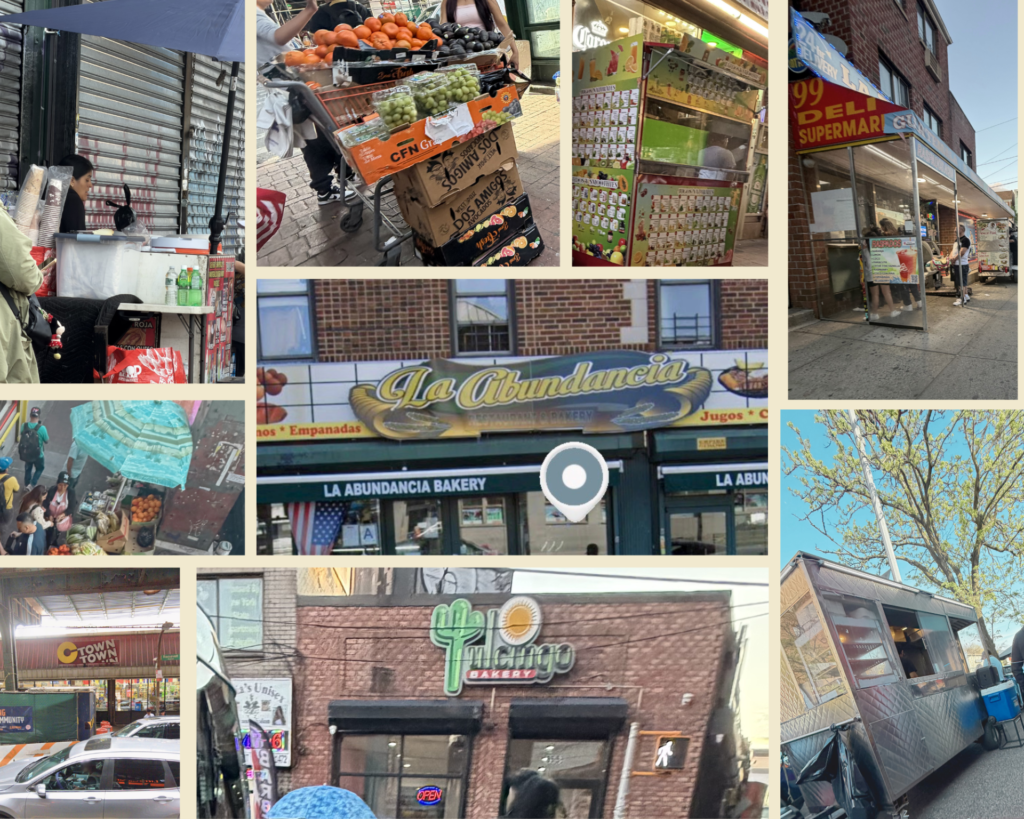
Observed Food spaces: Restaurants, vendors, and Retail Locations
Places: Mr.Ceba’s, C Town supermarket, FOOD BAZAAR, La Abundancia, Starbucks Coffee company, Chipotle Mexican Grill, Mi Esquinita Deli/market, and Local vendors
Significant further observations:
Mr. Ceba’s further observation:
The space is small and mostly used for quick meals, with many customers coming in, ordering, and leaving after a small amount of time. Most customers appeared to be local, working-class residents, and many interactions were in Spanish, showing the strong Latino presence in the neighborhood. The workers had a flexible division of labor, one focused on taking orders while another prepared food, but they switched when it got busy. The ordering system is simple: customers order at the counter if they want something quick or take out, or sit at a table if they want something more like a meal. The menu seems affordable and designed for everyday meals. There was noticeable takeout activity, with people quickly picking up food and leaving. The pace of the space changes throughout the day, with quiet periods followed by short busy moments. Interactions between workers and customers were brief but friendly, suggesting many repeat customers. Overall, Mr. Ceba’s reflects a neighborhood-focused food space that prioritizes affordability, speed, and cultural familiarity, serving the daily needs of the local community.
Deli (Mi Esquina) further observation:
The space is small and functions mainly as a quick stop for food and everyday items, with customers constantly coming in and out. Most customers seemed to be local residents, many stopping by briefly to buy snacks, drinks, or simple meals like sandwiches. The workers had overlapping roles, they prepared food, handled the register, and restocked items at the same time, showing a fast-paced and flexible work environment. The ordering system is informal and efficient. Customers either grab items directly or order at the counter, and service is quick. Prices appeared relatively affordable, making it accessible for regular, everyday use. Spanish was commonly spoken, along with some English, reflecting the neighborhood’s cultural makeup. There was a steady rhythm of activity, with no long lines but constant movement of people. Finally, what stood out to me is that it’s basically a “3 in 1” space. It works as a deli/small supermarket inside, but outside there’s also a Mexican food truck and a raspado (shaved ice) stand, all connected to the same spot.
Foodscape description: The area around the Junction Boulevard 7 train stop gives a clear image of how food, immigration, labor, and neighborhood life all come together in Corona. This part of Queens is not organized around upscale dining or heavily branded commercial chains. Instead, the food environment seems to be shaped mainly by small independent businesses, informal vending, takeout culture, and foods that reflect the immigrant communities who live and work in the area. Corona is known as one of the most immigrant-heavy neighborhoods in Queens, especially with strong Latin American communities, and that is visible in the kinds of restaurants, bakeries, bodegas, produce stores, and mobile vendors that appear along Roosevelt Avenue and the surrounding streets.
What stands out most in this foodscape is density and variety within a relatively small walking radius. There are places selling prepared meals, grab-and-go snacks, groceries, juices, baked goods, and street food all close together, which suggests that food here is tied to everyday survival and convenience as much as culture. The area also appears to be built around movement: people coming off the train, workers on break, parents shopping, students passing through, and delivery workers picking up orders. Nearby Corona Plaza and the Roosevelt Avenue corridor have also been associated with a large street-vendor presence, showing that food in this neighborhood is not limited to formal storefront businesses. Overall, the Junction Boulevard foodscape reflects a working-class, immigrant neighborhood where food is social, practical, and deeply tied to community life.
Address: Food Bazaar: 35-60 Junction Blvd, Corona, NY 11368
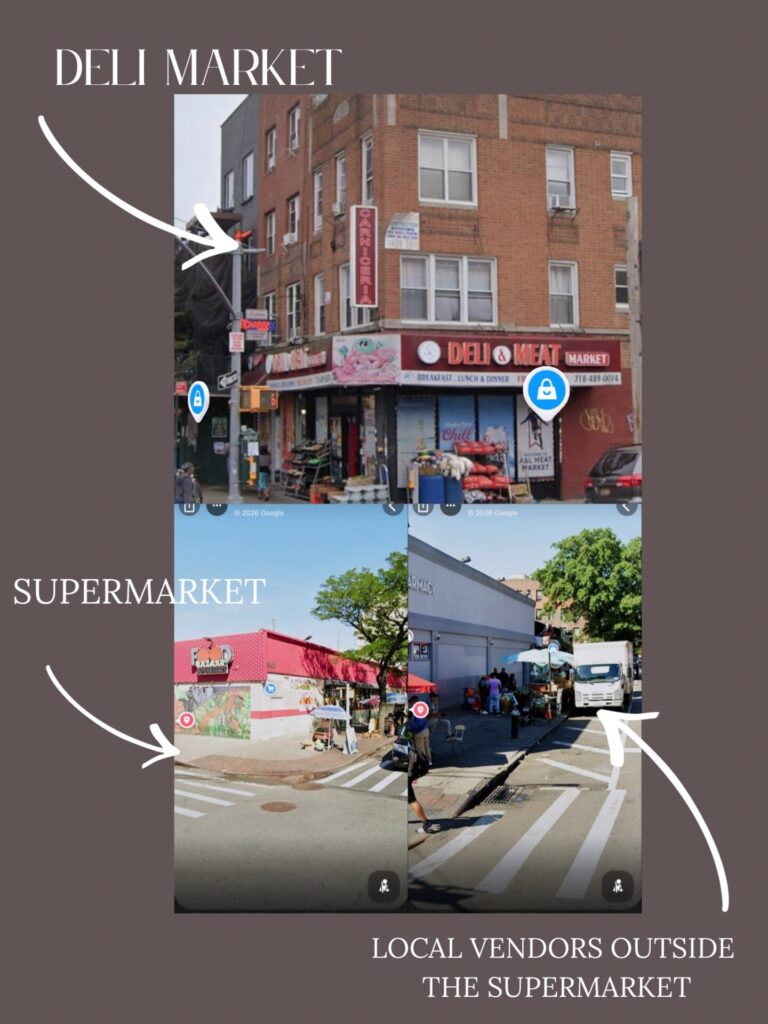
This collage represents three different food retail spaces in the same neighborhood: a deli and meat market, a large supermarket (Food Bazaar), and local vendors selling fruits and vegetables outside the supermarket. Together, these spaces show how the idea that “we are how we eat” is influenced by accessibility, price, and convenience, not just by personal preference. The phrase “we are how we eat” is significant because it suggests that our eating habits reveal our social position, our routines, and the structures around us, like work schedules, income, and neighborhood food environments, rather than being individual choices.
In my neighborhood, the deli and meat market is very close to my house, while the supermarket is about a fifteen‑minute walk away. The supermarket usually offers lower prices and a wider variety of products than the deli and meat market, but many of my neighbors still rely on the nearby deli because it provides quick and convenient access to food. For instance, in this case the meat at the deli is more expensive but very high quality compared to the supermarket, while vegetables and many other products are higher quality and lower cost in the supermarket, so people balance quality, price, and distance in different ways. People can call ahead to have meat prepared at the deli, which saves time, even though the prices are higher. Adding on, the local vendors outside the supermarket also make it easier for people to grab fruits and vegetables quickly without going inside and waiting in long lines. This shows how everyday eating practices are shaped by time pressure and proximity; people often eat in ways that fit their lives, even when it costs more or is not the best quality.
In Chapter 4, we learned how food retail has shifted from small neighborhood stores to large supermarket chains, which now control much of the food supply and shape where people shop and what they buy. Observing this space shows that even though large supermarkets dominate the food retail system, smaller markets and street vendors still play an important role in providing accessible food options for local communities. At the same time, convenience and proximity often influence what people buy more than price or nutritional quality. This makes “we are how we eat” show that the way we eat reflects the social structures around us, like our neighborhood, class, and the time demands, just as much as it reflects our identities or tastes.
QUESTION:
1. When we look at my neighborhood’s deli, supermarket, and street vendors, whose eating habits get judged as “bad choices” and whose are seen as normal or smart, and what does that reveal about class and stigma?
2. This also makes me wonder how time constantly shapes everyday eating habits. How does the need for convenience influence the balance between home cooking and purchasing food from restaurants or nearby retail spaces, especially when people have limited time and rely more on prepackaged or already prepared foods? Is the food system encouraging this pressure by making prepared food and grocery shopping (Instacart) more accessible, for example, through delivery apps and the grab-and-go options?
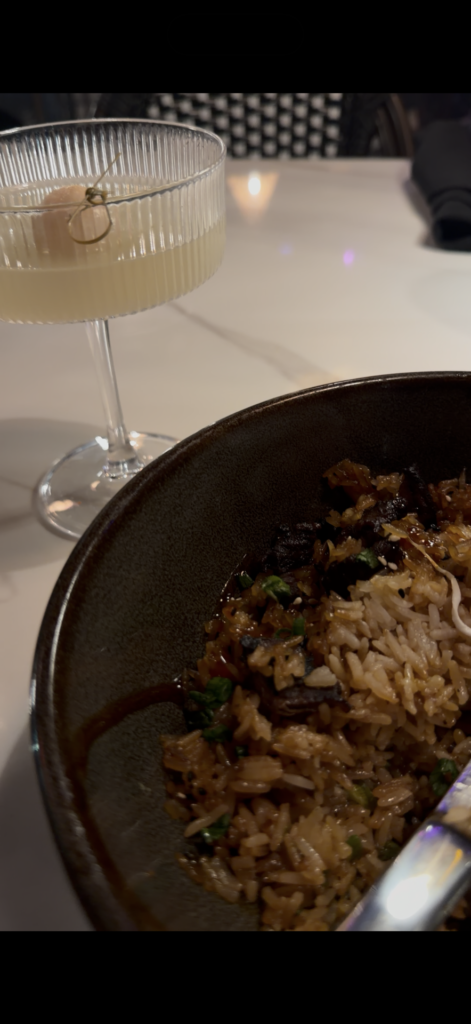
Eating out can be shaped by different aspects, not just by the food itself. When I went to the Romo restaurant, I noticed a very long line of people waiting outside because there were already a lot of people there. This was due to the fact that they didn’t have reservations. This made my experience interesting because I could see how excited many people were to eat at that restaurant, since it’s a nice place. It made me wonder why people are willing to wait just to eat at a specific restaurant. Sometimes people go to certain places because they are popular or trending at the moment, especially through social media. This shows that eating out can be influenced by popularity, status, and social trends. However, not everyone has the financial stability to treat eating out as a “choice” or as something they can do just to follow trends. For many people, where they eat depends more on affordability and access rather than popularity.
Question: How might the popularity or trendiness of a restaurant influence who can eat there, and can that trendiness also shape how people experience the food itself, making it seem better simply because the place is popular?
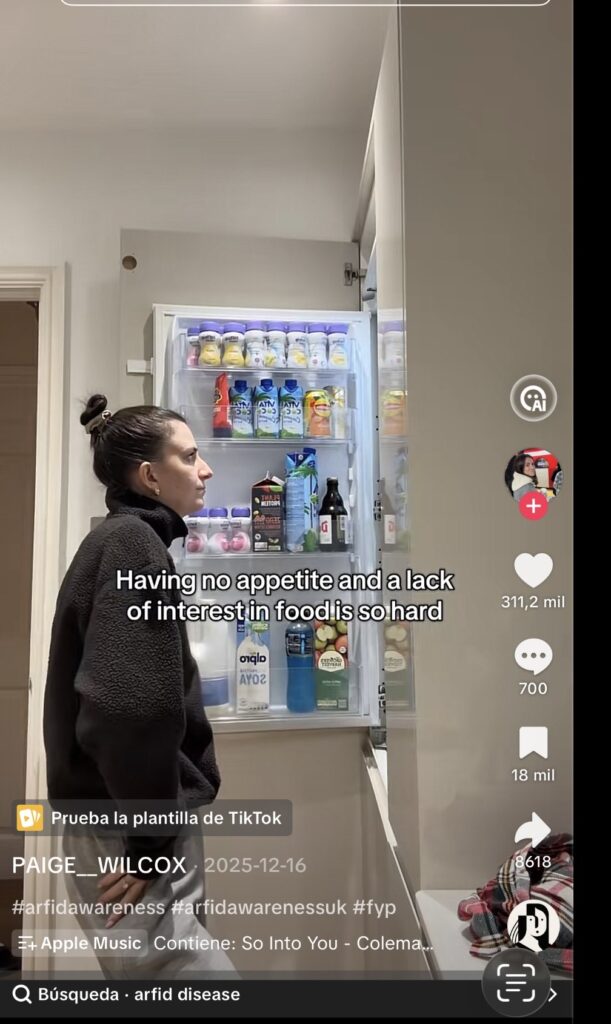
Most of the time, eating “in” is viewed as something normal that happens in every household, like a routine in which families cook and eat together at home or when someone cooks for themselves. However, these TikToks show that this is not always the reality. In one video, a student says they eat everything they see at school because they do not eat at home, suggesting that school becomes the main place where they can eat. In the other video, a person stands in front of a fridge full of food but says they have no appetite and struggles to eat, showing that simply having food available does not always mean someone can or wants to eat it. These situations may also reflect deeper issues beyond food itself, such as emotional stress, household dynamics, or a lack of support at home. As Raj Patel explains in Food Sovereignty: Power, Gender, and the Right to Food, hunger is often misunderstood as simply a lack of food, when in reality it can also be connected to power, entitlement, and people’s living conditions. In this way, eating at home can depend on factors such as who controls money, time, and care in the household, as well as the home’s emotional environment. These examples show that “eating in” is not always a simple personal choice but can also reflect broader social inequalities and family dynamics.
Question: What factors might influence why someone who has access to food at home still struggles to eat there, while others without access must rely on institutions like schools instead of “eating in”? Is it simply personal choice, or something shaped by larger social conditions?
Eating habits are highly influenced by social media today. Many people do not simply eat based on hunger or cultural tradition, but based on what is trending online. Influencers promote “what I eat in a day” videos, high-protein diets, green juices, gut health routines, and aesthetically curated meals that often become normalized as the “ideal” way to eat. This suggests that eating is not inherently personal; rather, it is socially constructed. When influencers label certain foods as clean, healthy, or superior, they transform how followers view their own bodies and food choices. Food becomes related to appearance, discipline, and even social status. Instead of eating primarily for nourishment, people may eat for aesthetics or validation. In this way, eating becomes a performance, especially when meals are photographed, filmed, and shared online.
To add on, there is a contradiction in digital food culture. While many influencers promote expensive “healthy” lifestyles, this includes supplements, protein powders, organic groceries, and specialty products, which not everyone can afford. This creates a standard of what “healthy eating” should look like. In contrast, mukbang videos on platforms like TikTok often show a large amount of fast food and high-calorie meals. These videos gain attention because they are visually dramatic, accessible, and relatable. For some viewers, it may feel easier to connect with or watch excessive fast-food consumption than to replicate expensive health trends. Both the restrictive “clean eating” and excessive mukbang consumption shape how audiences understand normal eating behaviors.
Not only that, influencers frequently profit from sponsorships, which connects eating directly to capitalism. Food trends are not just cultural; they are monetized. I wonder how much of what we eat is truly our own choice, and how much is shaped by digital trends, the economic inequality, and the invisible pressures of social media culture.
Ashley Alonzo (she/her)
Need help with the Commons?
Email us at [email protected] so we can respond to your questions and requests. Please email from your CUNY email address if possible. Or visit our help site for more information: